Article Section
IUPAC Nomenclature
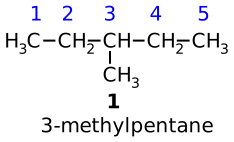
Systematic names (IUC or IUPAC or Geneva names): The common or trivial names are generally short and easy to remember but they suffer from many disadvantages.
As the number of carbon atoms increaes in an organic compoud the number of isomers also increases enormously. For example, there are 5 possible hexanes, 9 heptanes and 35 nonanes. Hence with larger alkanes the number of possible isomers becomes astronomic and it is difficult to give common names to them. It was, therefore, felt necessary to systematise the method of nomenclature so that each compound may be assigned an unambiguous name acceptable to the scientific world. The first effective consideration of organic nomenclature on an international basis came about in 1889 when an International Commission for the Reform of Chemical Nomenclature was organised. Three years later 34 of the leading chemists from 9 European countries met at Geneva and agreed upon what was known as the Geneva Rules for nomenclature. In 1911 an International Association of Chemical Societies was organised. Nomenclature reform was among the subjects considered by this group, but World War I disrupted the work before any recommendations were made. International cooperation was again initiated in 1920 when the International Union of Chemistry (IUC) was organised. At the IUC meeting in Brussels the following year, three commissions were appointed for the reform of chemical nomenclature: one for organic, a second for inorganic and a third for biological chemistry. Reports of these commissions were published in the Comptes rendus de l' Union Internationale de Chimie. World War II interrupted the work of the IUC and its commissions. In the year 1947 on a meeting of the IUC was held in London, and the name of the Union was changed to the International Union of Pure and Applied Chemistry (IUPAC) and the word “reform” was dropped from the names of its nomenclature commissions. The term systematic names emphasises the systematic derivation of these names. The IUPAC names are logical and highly definite as will be seen shortly. To sum up the most important feature of an IUPAC or systematic name is that a compound with a well-defined structure will have one and only one IUPAC or systematic name in terms of the principles underlying the IUPAC system of nomenclature.
| Functional Group | Secondary Suffix | Generic Name | Examples |
|---|---|---|---|
| Aldehydes (-CHO) | -al | Alkanal | Methanal |
| Ketones (>C=O) | -one | Alkanone | Propanone |
| Alcohols (-OH) | -ol | Alkanol | Methanol |
| Carboxylic acids (-COOH) | -oic acid | Alkanoic acid | Methanoic acid |
| Esters (-COOR) | -oate | Alkyl alkanoate | Methyl ethanoate |
| Acyl group (RCO-) | -oyl | Alkanoyl | Ethanoyl |
To Top
Hybridisation Concept and its Application on Simple Organic Molecules
Shape of orbitals: It is important to recall about the different shapes of orbitals that are present, before we take a look at the concept of hybridisation. Each shell in an atom (1st, 2nd, 3rd ... nth shell) has sub-shells known as s, p, d and f sub-shells. The 1st shell has only the s sub-shell, the 2nd shell has s and p sub-shells and so on. Each sub-shell has one or more set of orbital(s). s sub-shell has only the s orbital while p sub-shell has three p orbitals known as px, py and pz orbitals.
Here, the orbitals of 1st shell which consist of only the s orbital is denoted as 1s orbital. The orbitals of the 2nd shell which consist of s and p sub-shells are denoted as 2s and 2p sub-shell and also extended as 2s, 2px, 2py and 2pz orbitals.
What is an orbital?
An orbital is a probability of finding the electron(s). Thus, when we say an electron is in an s-orbital, we understand that it is an area of probability of finding that electron. Therefore, we have different shapes (area of probability of finding the electorn) of orbitals. s-orbital is spherical in shape (Fig 1). p-orbital is dumbel shaped and directed along the x, y or z axes with a node around the nucleus (Fig 2).

Fig 1: Shape of s-orbital
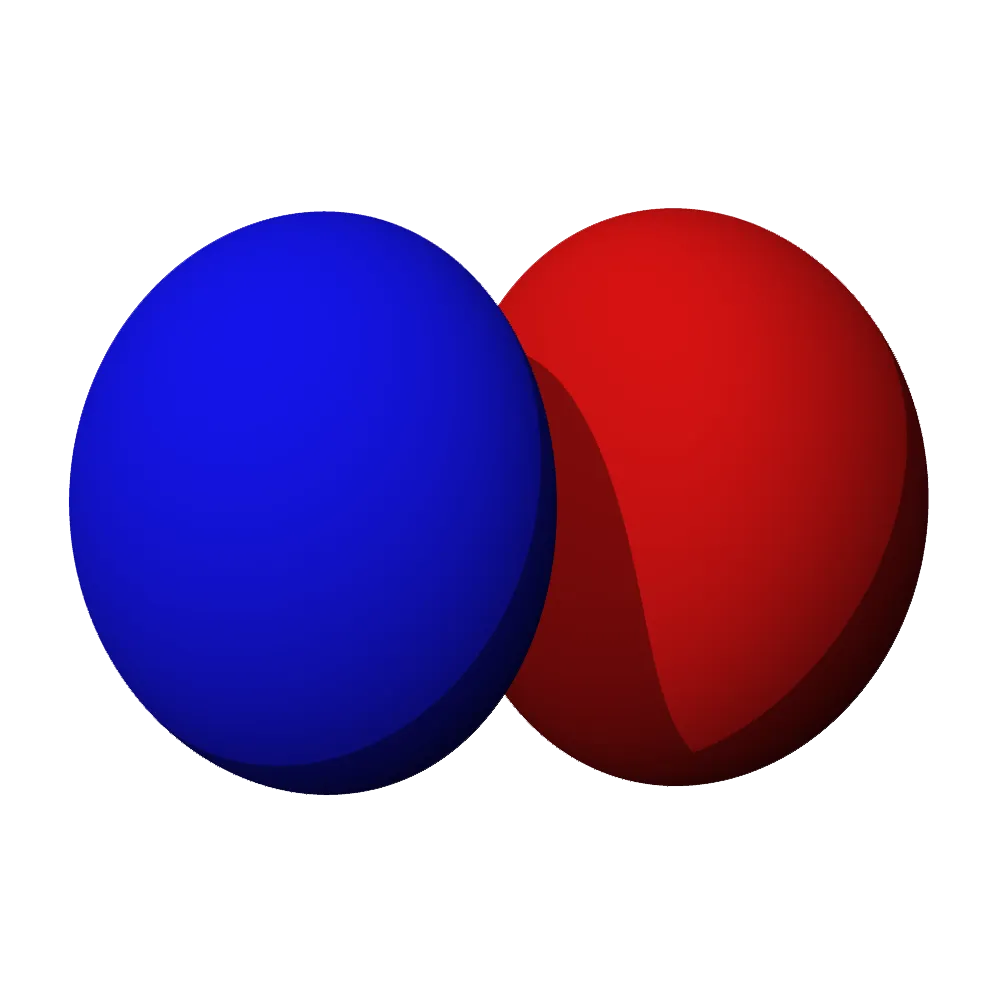
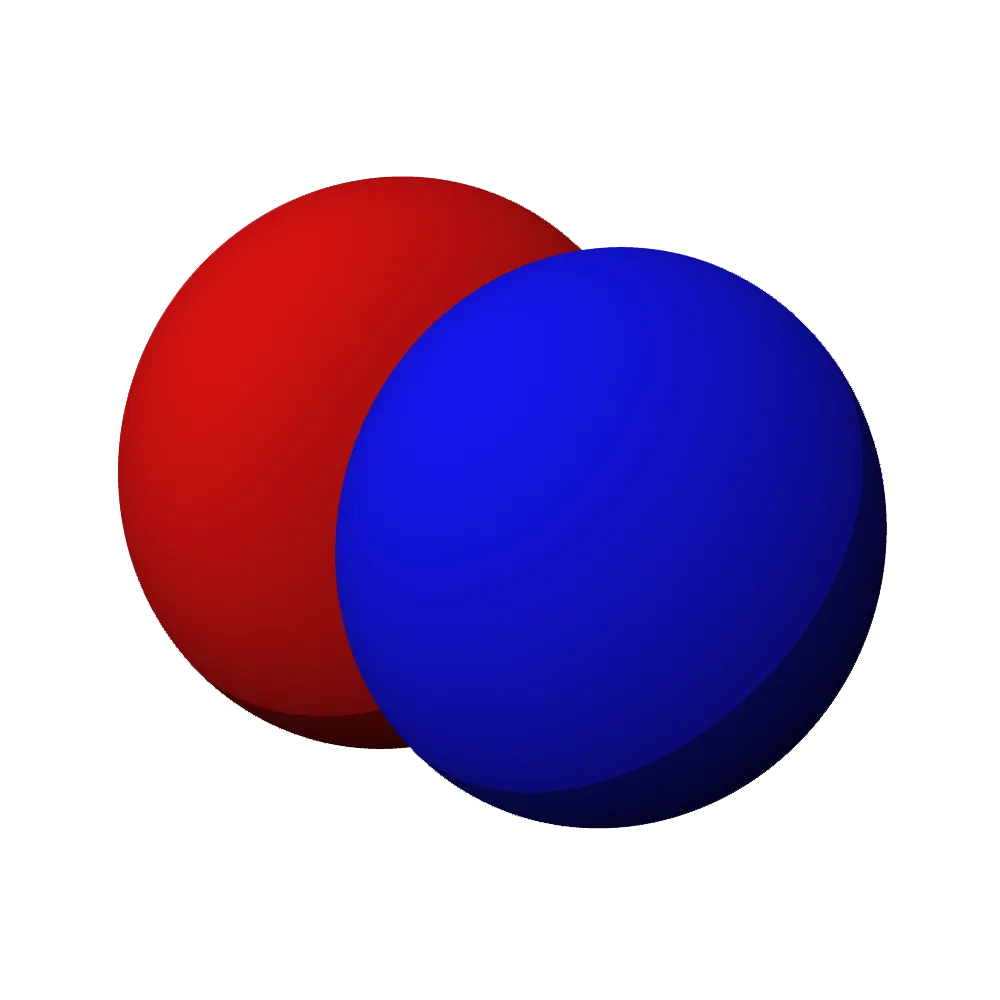
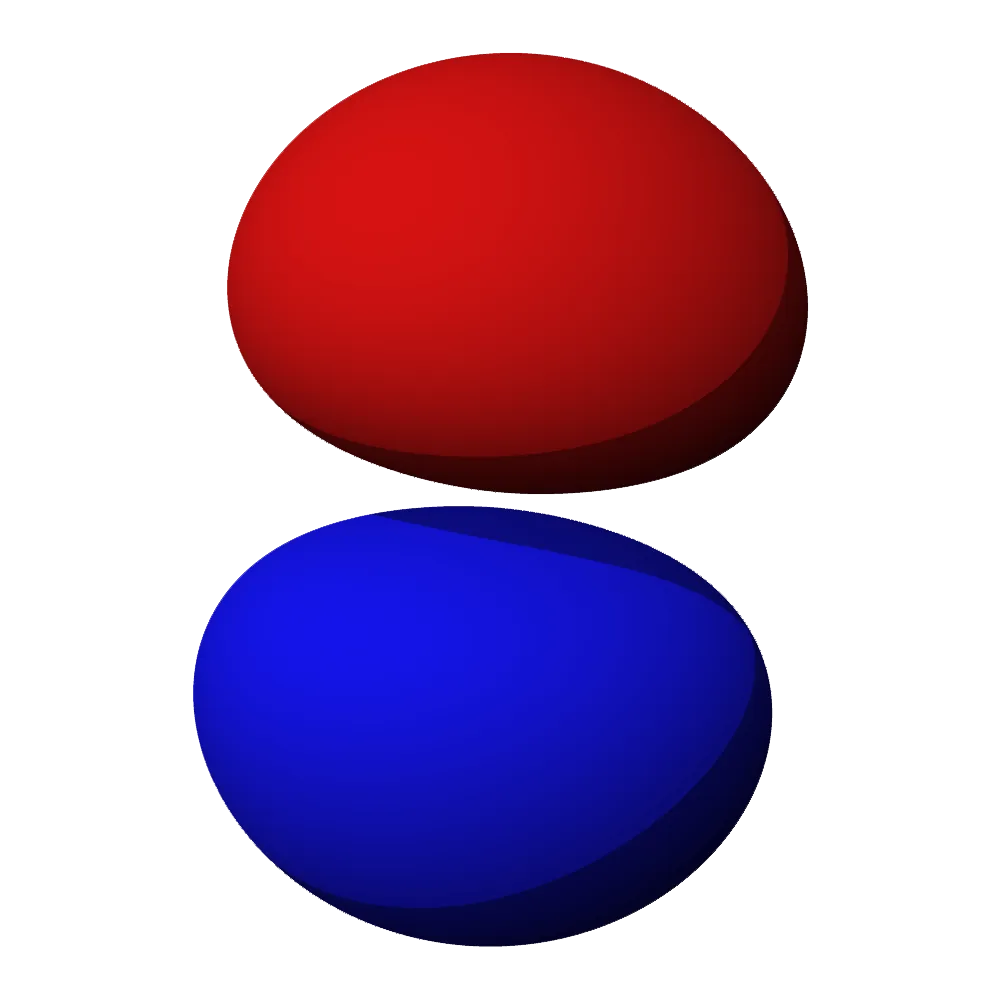
Fig 2: Shape of px-, py- and pz-orbital
Hybridisation of Atomic Orbitals: In this concept atomic orbitals of different shapes and has a small difference in energy, mix together to form a new sets of orbitals known as hybridised orbitals. The hybridised orbitals are of the same shaped and energy (called degenerate orbitals). The total number of hybridised orbital is equal to the total number of atomic orbitals that are hybridised.
For example, the s and p orbitals of the 2nd shell can mix to form hybrid orbitals as they have a small difference in energy but not between 1st and 2nd shell due to the large difference in energy. Thus, atomic orbitals like 2s and 2p can mix to form sp, sp2 or sp3 hybridised orbitals.
Carbon atom ground state electronic configuration is [He] 2s2 2px1 2py1 2pz0. Now, since the energy between 2s and 2p orbital is small, on excitation, one of the electron form 2s can jump to 2p orbital. Thus, Carbon atom excited state electronic configuration is [He] 2s1 2px1 2py1 2pz1. Here we see the excited state valence shell electronic configuration of carbon is 2s1 2px1 2py1 2pz1. If the 2s orbital mix with 2px orbital we get two sets of sp hybridised orbittals.
| Atomic Orbitals | Hybridised Orbitals |
|---|---|
| s + px (two AO) | sp + sp (two HO) |
| s + px + py (three AO) | sp2 + sp2 + sp2 (three HO) |
| s + px + py + pz (four AO) | sp3 + sp3 + sp3 + sp3 (four HO) |
| Note: AO - Atomic orbitals, HO - Hybridised Orbital | |
To Top
On Quantum Mechanics
The transition from classical physics to quantum mechanics shifted our understanding of reality. Classical physics views the universe as predictable and continuous. Quantum mechanics reveals a subatomic world governed by probabilities, wave-particle dualism, and discrete energy packets. Three core equations form the foundation of this framework.
Here I am using additional elements from MathML for displaying mathematical expression.
Planck-Einstein Relation: The Scientific BreakthroughIn 1900, Max Planck solved the "blackbody radiation" paradox by proposing that energy is not continuous. Instead, it is emitted or absorbed in discrete packets called quanta. A few years later, Albert Einstein applied this concept to light. He proved that light behaves like a stream of localized particles, which we now call photons
What the equation means:
- E: The energy of a single photon.
- h: Planck's constant, a fundamental constant of nature (6.626 × 10⁻³⁴ J·s).
- ν: The frequency of the electromagnetic wave.
De Broglie Wavelength: If light waves can act like particles, can particles act like waves? In 1924, French physicist Louis de Broglie proposed that matter possesses wave-like properties. He argued that any moving particle has an associated "matter wave."
What the equation means:
- λ: The de Broglie wavelength of the particle.
- h: Planck's constant.
- p: The momentum of the particle (p = mass × velocity).
The Schrödinger Equation: Once physicists accepted that matter behaves like a wave, they needed a rigorous way to calculate how these waves evolve. In 1925, Erwin Schrödinger formulated his famous wave equation. It replaced Newton's laws of motion for the subatomic realm.
What the equation means:
- Instead of calculating a precise trajectory (like a planet's orbit), this equation solves for the wavefunction (ψ).
- The Left Side : Represents how the wavefunction changes over time.
- The Right Side : Calculates the total energy of the system, combining kinetic energy (motion) and potential energy (V)
The Heisenberg Uncertainty Principle is one of the most famous and misunderstood laws in physics. Formulated by Werner Heisenberg in 1927, it states that you cannot simultaneously know both the precise position and precise momentum of a particle.
What the equation means:
- Δx: The uncertainty in position (how accurately you know where the particle is).
- Δp: The uncertainty in momentum (how accurately you know how fast it is moving and where it is going).
- ℏ: The reduced Planck's constant (h / 2π), which sets the fundamental scale of the quantum world.
I Think I Can Safely Say That Nobody Understands Quantum Mechanics
Richard Feynman
To Top
Matrix-Multiplication
A simple program to multiply two matrices using Fortran. This is part of a numerical problem solving class course. A simple program Fortran program to multiply a 3x3 matrix.
Example
This program would take an input file name matin.dat with simple matrix element of both A and B in the same file. After multiplying the matrices an output file matout.dat is created.
matrix.f file
 1│ c     program to multiply two matrix A and B
 2│       implicit real*8(a-h,o-z)
 3│       parameter(n=3,m=3)
 4│       dimension A(n,m),B(n,m),pdt(n,m)
 5│
 6│       open(unit=3,file='matin.dat')
 7│
 8│       do i=1,m
 9│           read(3,*)(A(i,j),j=1,n)
10│       enddo
11│
12│       do i=1,m
13│           read(3,*)(B(i,j),j=1,n)
14│       enddo
15│       close(3)
16│
17│       do i=1,m
18│           do j=1,n
19│           pdt(i,j) = 0.0
20│               do k=1,n
21│                    pdt(i,j) = pdt(i,j) + A(i,k)*B(k,j)
22│               enddo
23│           enddo
24│       enddo
25│
26│       open(unit=4,file='matout.dat',status='replace',form='formatted')
27│
28│       do i=1,n
29│           write(4,90)(pdt(i,j),j=1,m)
30│       enddo
31│    90 format(F8.2,F8.2,F8.2)
32│
33│       close(4)
34│
35│       stop
36│       END
matin.dat file sample
1│ 5   1   9
2│ 3   6   3
3│ 5   4   2
4│ 2   0   6
5│ 3   3   -1
6│ 7   0   5
matout.dat file output by the program
1│   76.00    3.00   74.00
2│   45.00   18.00   27.00
3│   36.00   12.00   36.00
Gauss-Jordan Elimination Method: For solving sets of linear equations, Gauss-Jordan elimination produces both the solution of the equations for one or more right-hand side vectors b, and also the matrix inverse A-1.
Example
x + y + 2 = 5
2x + 3y + 5z = 8
4x + 5z = 2
This can be written in agumented matrix form as follows:
The two matrices can be then use as input in to the gauss-jordan subroutine to find the solution for x, y and z.
The subroutine used here is adapted from Numerical Recipies
. You can find the subroutine and relevant files in my Github repo.
To Top
List and Definition
-
Chapter - I: Basic Concept
- Nomenclature of Organic Compounds
- Hybridisation Concept and its Application on Simple Organic Molecules
- Acid - Base Concept
- Inductive Effect, Hydrogen Bonding
- Conjugation, Resonance, Hyper-conjugation
- Types of Reagents
- Reactive Intermediates
-
Chapter - II: Organic Stereo Chemistry
- Concept of Isomerism
- Fischer, Newman and Sawhorse Projection Formulae
- Geometrical Isomerism
- Optical Isomerism
-
Chapter - III: Hydrocarbons
- Alkanes
- Cyloalkanes
- Alkenes
- Alkynes
- Aromatic Hydrocarbons
- Fortran
- Fortran is a high-level programming language developed by IBM in 1957. As the world's first widely used high-level language, it was designed specifically for complex mathematical, scientific, and engineering computations.
- Hybridisation
- It is a concept where atomic orbitals of different shapes that has a small difference in energy, mix together to form a new sets of orbitals known as hybridised orbitals.
List of elements that I have used on this kitchen sink
To Top
Remaining Elements
Using <meter> element.
How far have I used html elements:
There is a <template> and <slot> element below not visible on a browser.
<NEED NAME >
NEED DESCRIPTION
Attributes
None
Using <progress> element.
Using <picture> element.

Embedding this site using <embed> element.
Using <audio> element.
Using <canvas> element.
Using <dialog> element.
Using <data> element.
- iPhone 17 Pro: $1,099.00
- Samsung Galaxy S26 Ultra: $1,299.99
- Google Pixel 10 Pro: $999.00
- Xiaomi 16 Ultra: $1,099.00
Using <map> element.

Using <video> element.
This page is compiled by:
Farlando DiengdohShillong, Meghalaya, India
email: iykyk@mysite.com
To Top